Ensuring Traceable Precision in High-Torque Bolting
The 20% Rule (often referred to as the 20%–100% Rule) is a fundamental principle in the world of torque application. For professionals utilizing Heavy Duty Cordless Torque Wrenches in critical industries like Wind Energy, infrastructure, or Commercial Vehicle Maintenance, adhering to this rule is essential to guarantee the advertised accuracy of the tool.
🎯 What is the 20% Rule?
The 20% Rule dictates that a torque wrench must be operated within the range of 20% to 100% of its maximum capacity to ensure the highest level of accuracy and repeatability.
-
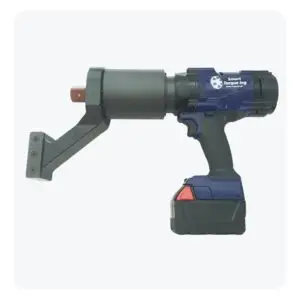
Example: If you own an Industrial Cordless Nut Runner with a maximum capacity of 200-2000 ft-lbs (approx. 2700 Nm), you should never use it to tighten fasteners requiring torque below 400 ft-lbs.
I. The Mechanical and Electrical Rationale
This rule is rooted in the physics and design of high-precision torque tools:
-
Non-Linearity at Low End: In both mechanical (click-type) and some older digital wrenches, the internal mechanism or sensor’s response tends to be non-linear or less sensitive at the very low end of its range. This translates directly to a higher percentage of error relative to the required torque value.
-
Calibration Standards: Reputable manufacturers calibrate their tools, providing NIST Traceability, only across the 20% to 100% range. Within this range, the tool’s performance is stable, ensuring that the tool’s Digital Display matches the actual output force.
-
Tolerance Implications: Below the 20% threshold, the absolute margin of error (4% of the reading) becomes a disproportionately large part of the small target torque, effectively making the reading less reliable.
📊 Torque Wrench Accuracy Range
| Usage Range | Example for a 1000 ft-lbs Wrench | Expected Accuracy | Practical Recommendation |
| 0% – 20% | 0 -200 ft-lbs | Accuracy is Degraded | Avoid Use (Use a smaller tool) |
| 20% – 80% | 200 ft-lbs – 800 ft-lbs | Optimal Certified Accuracy | The Ideal Working Range |
| 80% – 100% | 800ft-lbs – 1000 ft-lbs | Still Accurate, but increases wear | Use when necessary |
II. Practical Application and Tool Selection
Adhering to the 20% Rule dictates a smarter approach to tool purchasing and usage:
-
Smart Tool Selection: If your application requires a wide range of torque values-both high and low-it is always more economical and safer to invest in two separate torque wrenches (one 150 ft-lbs wrench and one 1500 ft-lbs wrench) rather than forcing one large tool to handle light duties.
-
Preventing Calibration Drift: The rule extends to tool storage. After use, the wrench should always be reset to its lowest setting (ideally 20% of its full scale). Storing the tool with the spring mechanism under constant tension (at a high setting) leads to premature fatigue and calibration drift, which compromises the tool’s ability to maintain its high-accuracy certification.
📅 Maintenance and Storage Table
| Action | Purpose | Rationale Based on 20% Rule |
| Tool Selection | Match tool to job | Ensure target torque falls above the 20% threshold. |
| Storage | Preserve spring integrity | Always reset the wrench to the minimum (or 20%) setting. |
| Calibration | Verify accuracy | Calibration is performed, and only certified, across the 20%-100% range. |
Conclusion
The 20% Rule is a clear mandate for reliability. For companies investing in expensive, high-capacity tools like the Hydraulic Wrench Alternative offered by modern battery technology, following this guideline protects that investment, maximizes tool lifespan, and most importantly, ensures that every critical fastener is tightened with guaranteed NIST Traceable precision.